


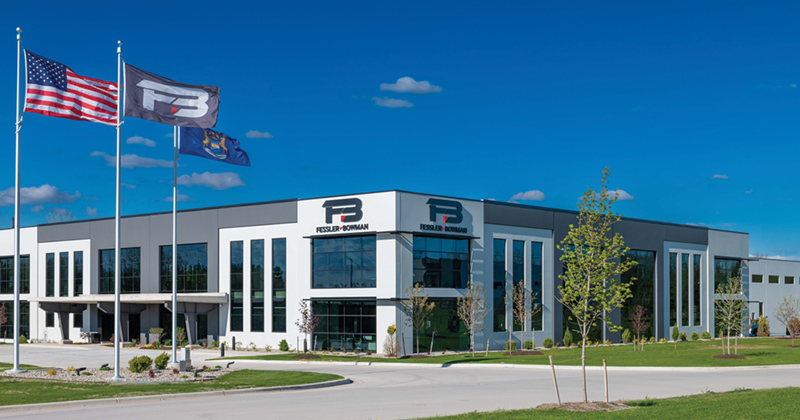
NewCrew sat down with Anne Brown, Chief of Staff at Fessler & Bowman (a leading concrete and civil infrastructure contractor), to explore how the company is using this emerging role to align teams, simplify operations, and sustain growth while focusing on its people.
You grew up around construction. Tell us about your background and what led you to your role at Fessler & Bowman.
I was raised in a construction office. My parents owned a large mason contracting company — one of the biggest in the country at the time — and I was in the office from birth. Some days I was paid, some days I wasn’t; in my teens I was a bit…feral. So, if I was in trouble, I got sent to the office to work for free.
I learned every part of how a construction company runs — estimating, accounting, job costing, operations. I later worked for a GC and then AGC of Michigan as Director of Workforce Development, but honestly, I missed being close to the work.
When I met leaders from Fessler & Bowman through my role at AGC — I knew this was the company I wanted to work for.
I started as Director of Client Development, but my work quickly evolved beyond that — strategy, operations, finance, labor relations, communications. It was clear the “client development” title didn’t fit what I was doing. We eventually called it what it truly was: Chief of Staff.
“Chief of Staff” isn’t a title you see often in construction. How do you define your role?
“My job is to make the complicated simple.”
Fessler & Bowman is a large self-perform contractor with operations across multiple states, and over a thousand team members. Our business units are diverse — different geographies, different cultures. My role is to connect all of that.
I work directly between our Leadership Team, and our business unit directors. I help align leadership vision with day-to-day operations. That can mean translating strategy into action, facilitating collaboration across departments, or simplifying a process that’s become too complex.
I sit in the bullpen with our project managers and engineers, not in an office upstairs. I travel to all our regions. I listen. I connect dots. I try to make sure that what’s being decided in the boardroom actually works for the people in the field.
What kinds of challenges land on your desk?
The ones that don’t have a clear owner.
If something is messy, cross-departmental, or politically sensitive, it usually ends up with me. I’ve been called the company’s Swiss Army knife, I’m the person who can say the hard thing in a room full of strong personalities.
“I spend a lot of time designing collaboration — who needs to be in the room, how often, and how to make that time valuable.”
You mentioned “quieting the noise.” What does that mean?
That’s been our internal theme this year.
In construction, it’s easy to get buried in constant noise — meetings, emails, phone calls, problems. Everyone’s hustling, everyone’s wearing too many hats. But you can’t move the company forward if you’re always reacting.
So “quieting the noise” means clearing the chaos so people can actually do their work, think strategically, and enjoy their jobs. So I’m looking for:
- Fewer meetings
- Clearer ownership on initiatives
- Processes standardized across regions
- Tighter connection between budgets, goals, and day-to-day execution
- Higher engagement in sessions that used to feel like reporting exercises
Can you give an example of when your role made a difference in how something turned out?
The biggest one recently was our strategic planning and budget process.
Historically, budgets were created at the corporate level and then handed down to business unit directors. But those directors were accountable for goals they didn’t help create.
This year, I pushed for those directors to be fully involved from the start — setting their own targets, shaping the strategy, and giving input on the numbers. Those sessions became energizing. Directors felt ownership over their goals. The process was faster, smoother, and constructive. It sounds simple, but it was transformational.
“When processes are simpler and people are happier — that’s the ROI of this role.”
How do you measure success in a role like yours?
When you can feel it.
Our company meetings feel different now — more honest, more collaborative, more human. People are more engaged. Leaders are connecting. And on a practical level, processes will be simpler, teams more efficient, and we’ll save time and overhead.
“When we finally had an all-company meeting where everyone was genuinely engaged, vulnerable, and collaborating — that was the first time I thought, okay, we’re getting it right. We’ve got to stop assuming everyone hears decisions the same way. How leadership communicates determines how the field feels.”
If the company can move faster with less noise, if leaders can make decisions with better context, if people feel heard — then the Chief of Staff is doing their job.
What kind of company is ready for a Chief of Staff?
It’s not about size — it’s about complexity.
If you’re scaling, adding new services or offices, or if you’re in that stage where your leadership team has great ideas but need a conduit to the team to bring them to life — that’s when you need a Chief of Staff.
“When a company grows fast, you start to outpace your structure. Everyone’s running hard, but you lose alignment.”
A CEO and COO can’t be in every detail of execution. They need someone who can bridge the vision and the operations — who can take a 10,000-foot idea and make it actionable for the people on the ground.
What traits make someone a great Chief of Staff in construction?
You need someone who understands both finance and field operations — how money, manpower, and materials actually move through a project.
You also need to respect, understand and empathize with every role in the company. The ability to communicate across a large variety of people and departments is everything.
“You have to be able to speak CFO and Superintendent in the same sentence.”
And you have to be comfortable taking hits. If you’re doing your job right, you’re often the one delivering uncomfortable truths — but in a way that builds trust instead of breaking it.
What advice would you give to owners who can’t hire a Chief of Staff yet?
Act like you have one.
Before you announce any new initiative, stop and think through how it affects every department — payroll, AR/AP, operations, HR, accounting, field teams. Consider who needs to be in the room early, and how to communicate the change so it’s clear and achievable.
Key Takeaways
- Make the complicated simple: The Chief of Staff role turns chaos into clarity.
- Involve leaders early: Collaboration creates accountability and better results.
- Quiet the noise: Simplifying communication and process drives productivity.
- Culture is measurable: Engagement, trust, and collaboration are leading indicators of success.
- Construction fluency matters: A Chief of Staff must understand the industry’s unique language and pressures.
If your construction company is growing and your leadership team feels stretched thin, consider how a Chief of Staff could help you bridge the gap between strategy and execution.


